Asparagine (symbol Asn or N[2]), is an α-amino acid that is used in the biosynthesis of proteins. It contains an α-amino group (which is in the protonated −NH+
3 form under biological conditions), an α-carboxylic acid group (which is in the deprotonated −COO− form under biological conditions), and a side chain carboxamide, classifying it as a polar (at physiological pH), aliphatic amino acid. It is non-essential in humans, meaning the body can synthesize it. It is encoded by the codons AAU and AAC.
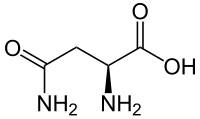


 ?)
?)A reaction between asparagine and reducing sugars or other source of carbonyls produces acrylamide in food when heated to sufficient temperature. These products occur in baked goods such as French fries, potato chips, and toasted bread.
History
Asparagine was first isolated in 1806 in a crystalline form by French chemists Louis Nicolas Vauquelin and Pierre Jean Robiquet (then a young assistant) from asparagus juice,[3][4] in which it is abundant, hence the chosen name. It was the first amino acid to be isolated.[5]
Three years later, in 1809, Pierre Jean Robiquet identified a substance from liquorice root with properties which he qualified as very similar to those of asparagine,[6] and which Plisson identified in 1828 as asparagine itself.[7][8]
The determination of asparagine's structure required decades of research. The empirical formula for asparagine was first determined in 1833 by the French chemists Antoine François Boutron Charlard and Théophile-Jules Pelouze; in the same year, the German chemist Justus Liebig provided a more accurate formula.[9][10] In 1846 the Italian chemist Raffaele Piria treated asparagine with nitrous acid, which removed the molecule's amine (–NH2) groups and transformed asparagine into malic acid.[11] This revealed the molecule's fundamental structure: a chain of four carbon atoms. Piria thought that asparagine was a diamide of malic acid;[12] however, in 1862 the German chemist Hermann Kolbe showed that this surmise was wrong; instead, Kolbe concluded that asparagine was an amide of an amine of succinic acid.[13] In 1886, the Italian chemist Arnaldo Piutti (1857–1928) discovered a mirror image or "enantiomer" of the natural form of asparagine, which shared many of asparagine's properties, but which also differed from it.[14] Since the structure of asparagine was still not fully known – the location of the amine group within the molecule was still not settled[15] – Piutti synthesized asparagine and thus published its true structure in 1888.[16]
Structural function in proteins
Since the asparagine side-chain can form hydrogen bond interactions with the peptide backbone, asparagine residues are often found near the beginning of alpha-helices as asx turns and asx motifs, and in similar turn motifs, or as amide rings, in beta sheets. Its role can be thought as "capping" the hydrogen bond interactions that would otherwise be satisfied by the polypeptide backbone.
Asparagine also provides key sites for N-linked glycosylation, modification of the protein chain with the addition of carbohydrate chains. Typically, a carbohydrate tree can solely be added to an asparagine residue if the latter is flanked on the C side by X-serine or X-threonine, where X is any amino acid with the exception of proline.[17]
Asparagine can be hydroxylated in the HIF1 hypoxia inducible transcription factor. This modification inhibits HIF1-mediated gene activation.[18]
Sources
Dietary sources
Asparagine is not essential for humans, which means that it can be synthesized from central metabolic pathway intermediates and is not required in the diet.
Asparagine is found in:
- Animal sources: dairy, whey, beef, poultry, eggs, fish, lactalbumin, seafood
- Plant sources: asparagus, potatoes, legumes, nuts, seeds, soy, whole grains
Biosynthesis
The precursor to asparagine is oxaloacetate. Oxaloacetate is converted to aspartate using a transaminase enzyme. The enzyme transfers the amino group from glutamate to oxaloacetate producing α-ketoglutarate and aspartate. The enzyme asparagine synthetase produces asparagine, AMP, glutamate, and pyrophosphate from aspartate, glutamine, and ATP. In the asparagine synthetase reaction, ATP is used to activate aspartate, forming β-aspartyl-AMP. Glutamine donates an ammonium group, which reacts with β-aspartyl-AMP to form asparagine and free AMP.

Degradation
Asparagine usually enters the citric acid cycle in humans as oxaloacetate.[19] In bacteria, the degradation of asparagine leads to the production of oxaloacetate which is the molecule which combines with citrate in the citric acid cycle (Krebs cycle). Asparagine is hydrolyzed to aspartate by asparaginase. Aspartate then undergoes transamination to form glutamate and oxaloacetate from alpha-ketoglutarate.
Function
Asparagine is required for development and function of the brain.[20] The availability of asparagine is also important for protein synthesis during replication of poxviruses.[21]
The addition of N-acetylglucosamine to asparagine is performed by oligosaccharyltransferase enzymes in the endoplasmic reticulum.[22] This glycosylation is important both for protein structure[23] and protein function.[24]
Zwitterion structure

Alleged cancer link in laboratory mice
According to a 2018 article in The Guardian, a study found that decreasing levels of asparagine "dramatically" reduced the spread of breast cancer in laboratory mice.[25][26] The article noted that similar studies had not been conducted in humans.
| This article uses material from the Wikipedia article Metasyntactic variable, which is released under the Creative Commons Attribution-ShareAlike 3.0 Unported License. |