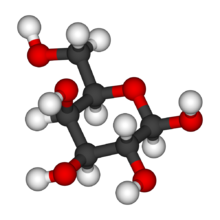
Galactose (/ɡəˈlæktoʊs/, galacto- + -ose, "milk sugar") sometimes abbreviated Gal, is a monosaccharide sugar that is about as sweet as glucose, and about 65% as sweet as sucrose.[2] It is an aldohexose and a C-4 epimer of glucose.[3] A galactose molecule linked with a glucose molecule forms a lactose molecule.


Galactan is a polymeric form of galactose found in hemicellulose, and forming the core of the galactans, a class of natural polymeric carbohydrates.[4]
Etymology
The word galactose was coined by Charles Weissman[5] in the mid 19th century and is derived from Greek galaktos (of milk) and the generic chemical suffix for sugars -ose.[6] The etymology is comparable to that of the word lactose in that both contain roots meaning "milk sugar". Lactose is a disaccharide of galactose plus glucose.
Structure and isomerism
Galactose exists in both open-chain and cyclic form. The open-chain form has a carbonyl at the end of the chain.
Four isomers are cyclic, two of them with a pyranose (six-membered) ring, two with a furanose (five-membered) ring. Galactofuranose occurs in bacteria, fungi and protozoa,[7][8] and is recognized by a putative chordate immune lectin intelectin through its exocyclic 1,2-diol. In the cyclic form there are two anomers, named alpha and beta, since the transition from the open-chain form to the cyclic form involves the creation of a new stereocenter at the site of the open-chain carbonyl. In the beta form, the alcohol group is in the equatorial position, whereas in the alpha form, the alcohol group is in the axial position.[9]
The IR spectra for galactose shows a broad, strong stretch from roughly wavenumber 2500 cm−1 to wavenumber 3700 cm−1.[10]
The Proton NMR spectra for galactose includes peaks at 4.7 ppm (D2O), 4.15 ppm (–CH2OH), 3.75, 3.61, 3.48 and 3.20 ppm (–CH2 of ring), 2.79–1.90 ppm (–OH).[10]


Relationship to lactose
Galactose is a monosaccharide. When combined with glucose (monosaccharide), through a condensation reaction, the result is a disaccharide called lactose. The hydrolysis of lactose to glucose and galactose is catalyzed by the enzymes lactase and β-galactosidase. The latter is produced by the lac operon in Escherichia coli.[citation needed]
In nature, lactose is found primarily in milk and milk products. Consequently, various food products made with dairy-derived ingredients can contain lactose.[11] Galactose metabolism, which converts galactose into glucose, is carried out by the three principal enzymes in a mechanism known as the Leloir pathway. The enzymes are listed in the order of the metabolic pathway: galactokinase (GALK), galactose-1-phosphate uridyltransferase (GALT), and UDP-galactose-4’-epimerase (GALE).[citation needed]
In human lactation, glucose is changed into galactose via hexoneogenesis to enable the mammary glands to secrete lactose. However, most lactose in breast milk is synthesized from galactose taken up from the blood, and only 35±6% is made from galactose from de novo synthesis.[12] Glycerol also contributes some to the mammary galactose production.[13]
Metabolism


Glucose is more stable than galactose and is less susceptible to the formation of nonspecific glycoconjugates, molecules with at least one sugar attached to a protein or lipid. Many speculate that it is for this reason that a pathway for rapid conversion from galactose to glucose has been highly conserved among many species.[14]
The main pathway of galactose metabolism is the Leloir pathway; humans and other species, however, have been noted to contain several alternate pathways, such as the De Ley Doudoroff Pathway. The Leloir pathway consists of the latter stage of a two-part process that converts β-D-galactose to UDP-glucose. The initial stage is the conversion of β-D-galactose to α-D-galactose by the enzyme, mutarotase (GALM). The Leloir pathway then carries out the conversion of α-D-galactose to UDP-glucose via three principal enzymes: Galactokinase (GALK) phosphorylates α-D-galactose to galactose-1-phosphate, or Gal-1-P; Galactose-1-phosphate uridyltransferase (GALT) transfers a UMP group from UDP-glucose to Gal-1-P to form UDP-galactose; and finally, UDP galactose-4’-epimerase (GALE) interconverts UDP-galactose and UDP-glucose, thereby completing the pathway.[15]
The above mechanisms for galactose metabolism are necessary because the human body cannot directly convert galactose into energy, and must first go through one of these processes in order to utilize the sugar.[16]
Galactosemia is an inability to properly break down galactose due to a genetically inherited mutation in one of the enzymes in the Leloir pathway. As a result, the consumption of even small quantities is harmful to galactosemics.[17]
Sources
Galactose is found in dairy products, avocados, sugar beets, other gums and mucilages. It is also synthesized by the body, where it forms part of glycolipids and glycoproteins in several tissues; and is a by-product from the third-generation ethanol production process (from macroalgae).[citation needed]
Clinical significance
Chronic systemic exposure of mice, rats, and Drosophila to D-galactose causes the acceleration of senescence (aging). It has been reported that high dose exposure of D-galactose (120 mg/Kg) can cause reduced sperm concentration and sperm motility in rodent and has been extensively used as an aging model when administered subcutaneous.[18][19][20] Two studies have suggested a possible link between galactose in milk and ovarian cancer.[21][22] Other studies show no correlation, even in the presence of defective galactose metabolism.[23][24] More recently, pooled analysis done by the Harvard School of Public Health showed no specific correlation between lactose-containing foods and ovarian cancer, and showed statistically insignificant increases in risk for consumption of lactose at 30 g/day.[25] More research is necessary to ascertain possible risks.[citation needed]
Some ongoing studies suggest galactose may have a role in treatment of focal segmental glomerulosclerosis (a kidney disease resulting in kidney failure and proteinuria).[26] This effect is likely to be a result of binding of galactose to FSGS factor.[27]
Galactose is a component of the antigens present on blood cells that determine blood type within the ABO blood group system. In O and A antigens, there are two monomers of galactose on the antigens, whereas in the B antigens there are three monomers of galactose.[28]
A disaccharide composed of two units of galactose, galactose-alpha-1,3-galactose (alpha-gal), has been recognized as a potential allergen present in mammal meat. Alpha-gal allergy may be triggered by lone star tick bites.[citation needed]
Galactose in sodium saccharin solution has also been found to cause conditioned flavor avoidance in adult female rats within a laboratory setting when combined with intragastric injections.[29] The reason for this flavor avoidance is still unknown, however it is possible that a decrease in the levels of the enzymes required to convert galactose to glucose in the liver of the rats could be responsible.[29]
History
In 1855, E. O. Erdmann noted that hydrolysis of lactose produced a substance besides glucose.[30][31]
Galactose was first isolated and studied by Louis Pasteur in 1856 and he called it "lactose".[32] In 1860, Berthelot renamed it "galactose" or "glucose lactique".[33][34] In 1894, Emil Fischer and Robert Morrell determined the configuration of galactose.
| This article uses material from the Wikipedia article Metasyntactic variable, which is released under the Creative Commons Attribution-ShareAlike 3.0 Unported License. |