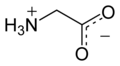
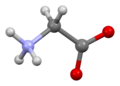
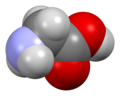
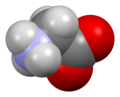
Glycine (symbol Gly or G;[6] /ˈɡlaɪsiːn/)[7] is an amino acid that has a single hydrogen atom as its side chain. It is the simplest stable amino acid (carbamic acid is unstable), with the chemical formula NH2‐CH2‐COOH. Glycine is one of the proteinogenic amino acids. It is encoded by all the codons starting with GG (GGU, GGC, GGA, GGG). Glycine is integral to the formation of alpha-helices in secondary protein structure due to its compact form. For the same reason, it is the most abundant amino acid in collagen triple-helices. Glycine is also an inhibitory neurotransmitter – interference with its release within the spinal cord (such as during a Clostridium tetani infection) can cause spastic paralysis due to uninhibited muscle contraction.




 ?)
?)Glycine is a colorless, sweet-tasting crystalline solid. It is the only achiral proteinogenic amino acid. It can fit into hydrophilic or hydrophobic environments, due to its minimal side chain of only one hydrogen atom. The acyl radical is glycyl.
History and etymology
Glycine was discovered in 1820 by the French chemist Henri Braconnot when he hydrolyzed gelatin by boiling it with sulfuric acid.[8] He originally called it "sugar of gelatin",[9][10] but the French chemist Jean-Baptiste Boussingault showed that it contained nitrogen.[11] The American scientist Eben Norton Horsford, then a student of the German chemist Justus von Liebig, proposed the name "glycocoll";[12][13] however, the Swedish chemist Berzelius suggested the simpler name "glycine".[14][15] The name comes from the Greek word γλυκύς "sweet tasting"[16] (which is also related to the prefixes glyco- and gluco-, as in glycoprotein and glucose). In 1858, the French chemist Auguste Cahours determined that glycine was an amine of acetic acid.[17]
Production
Although glycine can be isolated from hydrolyzed protein, this is not used for industrial production, as it can be manufactured more conveniently by chemical synthesis.[18] The two main processes are amination of chloroacetic acid with ammonia, giving glycine and ammonium chloride,[19] and the Strecker amino acid synthesis,[20] which is the main synthetic method in the United States and Japan.[21] About 15 thousand tonnes are produced annually in this way.[22]
Glycine is also cogenerated as an impurity in the synthesis of EDTA, arising from reactions of the ammonia coproduct.[23]
Chemical reactions
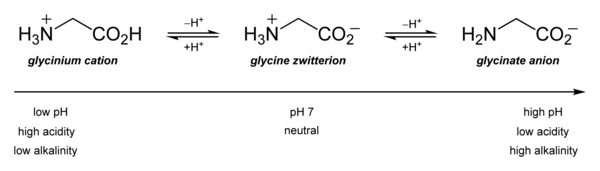
Its acid–base properties are most important. In aqueous solution, glycine itself is amphoteric: at low pH the molecule can be protonated with a pKa of about 2.4 and at high pH it loses a proton with a pKa of about 9.6 (precise values of pKa depend on temperature and ionic strength).
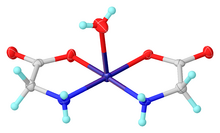
Glycine functions as a bidentate ligand for many metal ions. A typical complex is Cu(glycinate)2, i.e. Cu(H2NCH2CO2)2, which exists both in cis and trans isomers.
As a bifunctional molecule, glycine reacts with many reagents. These can be classified into N-centered and carboxylate-center reactions.
The amine undergoes the expected reactions. With acid chlorides, one obtains the amidocarboxylic acid, such as hippuric acid[24] and acetylglycine.[25] With nitrous acid, one obtains glycolic acid (van Slyke determination). With methyl iodide, the amine becomes quaternized to give trimethylglycine, a natural product:
- H
3N+
CH
2COO−
+ 3 CH3I → (CH
3)
3N+
CH
2COO−
+ 3 HI
Glycine condenses with itself to give peptides, beginning with the formation of glycylglycine:
- 2 H
3N+
CH
2COO−
→ H
3N+
CH
2CONHCH
2COO−
+ H2O
Pyrolysis of glycine or glycylglycine gives 2,5-diketopiperazine, the cyclic diamide.
Glycine hydrochloride is the hydrochloride salt formed by the combination of glycine with hydrogen chloride. It is a chemical compound with the molecular formula C2H6ClNO2. It appears as a white powder with a melting point of 176-180 °C.
Metabolism
Biosynthesis
Glycine is not essential to the human diet, as it is biosynthesized in the body from the amino acid serine, which is in turn derived from 3-phosphoglycerate, but the metabolic capacity for glycine biosynthesis does not satisfy the need for collagen synthesis.[26] In most organisms, the enzyme serine hydroxymethyltransferase catalyses this transformation via the cofactor pyridoxal phosphate:[27]
- serine + tetrahydrofolate → glycine + N5,N10-methylene tetrahydrofolate + H2O
In the liver of vertebrates, glycine synthesis is catalyzed by glycine synthase (also called glycine cleavage enzyme). This conversion is readily reversible:[27]
- CO2 + NH+
4 + N5,N10-methylene tetrahydrofolate + NADH + H+ ⇌ Glycine + tetrahydrofolate + NAD+
In addition to being synthesized from serine, glycine can also be derived from threonine, choline or hydroxyproline via inter-organ metabolism of the liver and kidneys.[28]
Degradation
Glycine is degraded via three pathways. The predominant pathway in animals and plants is the reverse of the glycine synthase pathway mentioned above. In this context, the enzyme system involved is usually called the glycine cleavage system:[27]
- Glycine + tetrahydrofolate + NAD+ ⇌ CO2 + NH+
4 + N5,N10-methylene tetrahydrofolate + NADH + H+
In the second pathway, glycine is degraded in two steps. The first step is the reverse of glycine biosynthesis from serine with serine hydroxymethyl transferase. Serine is then converted to pyruvate by serine dehydratase.[27]
In the third pathway of its degradation, glycine is converted to glyoxylate by D-amino acid oxidase. Glyoxylate is then oxidized by hepatic lactate dehydrogenase to oxalate in an NAD+-dependent reaction.[27]
The half-life of glycine and its elimination from the body varies significantly based on dose.[29] In one study, the half-life varied between 0.5 and 4.0 hours.[29]
Glycine is extremely sensitive to antibiotics which target folate, and blood glycine levels drop severely within a minute of antibiotic injections. Some antibiotics can deplete more than 90% of glycine within a few minutes of being administered.[30]
Physiological function
The principal function of glycine is it act as a precursor to proteins. Most proteins incorporate only small quantities of glycine, a notable exception being collagen, which contains about 35% glycine due to its periodically repeated role in the formation of collagen's helix structure in conjunction with hydroxyproline.[27][31] In the genetic code, glycine is coded by all codons starting with GG, namely GGU, GGC, GGA and GGG.
As a biosynthetic intermediate
In higher eukaryotes, δ-aminolevulinic acid, the key precursor to porphyrins, is biosynthesized from glycine and succinyl-CoA by the enzyme ALA synthase. Glycine provides the central C2N subunit of all purines.[27]
As a neurotransmitter
Glycine is an inhibitory neurotransmitter in the central nervous system, especially in the spinal cord, brainstem, and retina. When glycine receptors are activated, chloride enters the neuron via ionotropic receptors, causing an inhibitory postsynaptic potential (IPSP). Strychnine is a strong antagonist at ionotropic glycine receptors, whereas bicuculline is a weak one. Glycine is a required co-agonist along with glutamate for NMDA receptors. In contrast to the inhibitory role of glycine in the spinal cord, this behaviour is facilitated at the (NMDA) glutamatergic receptors which are excitatory.[32] The LD50 of glycine is 7930 mg/kg in rats (oral),[33] and it usually causes death by hyperexcitability.
Uses
In the US, glycine is typically sold in two grades: United States Pharmacopeia (“USP”), and technical grade. USP grade sales account for approximately 80 to 85 percent of the U.S. market for glycine. If purity greater than the USP standard is needed, for example for intravenous injections, a more expensive pharmaceutical grade glycine can be used. Technical grade glycine, which may or may not meet USP grade standards, is sold at a lower price for use in industrial applications, e.g., as an agent in metal complexing and finishing.[34]
Animal and human foods
Glycine is not widely used in foods for its nutritional value, except in infusions. Instead glycine's role in food chemistry is as a flavorant. It is mildly sweet, and it counters the aftertaste of saccharine. It also has preservative properties, perhaps owing to its complexation to metal ions. Metal glycinate complexes, e.g. copper(II) glycinate are used as supplements for animal feeds.[22]
Chemical feedstock
Glycine is an intermediate in the synthesis of a variety of chemical products. It is used in the manufacture of the herbicides glyphosate,[36] iprodione, glyphosine, imiprothrin, and eglinazine.[22] It is used as an intermediate of the medicine such as thiamphenicol.[citation needed]
Laboratory research
Glycine is a significant component of some solutions used in the SDS-PAGE method of protein analysis. It serves as a buffering agent, maintaining pH and preventing sample damage during electrophoresis. Glycine is also used to remove protein-labeling antibodies from Western blot membranes to enable the probing of numerous proteins of interest from SDS-PAGE gel. This allows more data to be drawn from the same specimen, increasing the reliability of the data, reducing the amount of sample processing, and number of samples required. This process is known as stripping.
Presence in space
The presence of glycine outside the earth was confirmed in 2009, based on the analysis of samples that had been taken in 2004 by the NASA spacecraft Stardust from comet Wild 2 and subsequently returned to earth. Glycine had previously been identified in the Murchison meteorite in 1970.[37] The discovery of cometary glycine bolstered the hypothesis of panspermia, which claims that the "building blocks" of life are widespread throughout the universe.[38] In 2016, detection of glycine within Comet 67P/Churyumov–Gerasimenko by the Rosetta spacecraft was announced.[39]
The detection of glycine outside the Solar System in the interstellar medium has been debated.[40] In 2008, the Max Planck Institute for Radio Astronomy discovered the spectral lines of a glycine-like molecule aminoacetonitrile in the Large Molecule Heimat, a giant gas cloud near the galactic center in the constellation Sagittarius.[41]
Evolution
Several independent evolutionary studies using different types of data have suggested that glycine belongs to a group of amino acids that constituted the early genetic code.[42][43][44][45] For example, low complexity regions (in proteins), that may resemble the proto-peptides of the early genetic code are highly enriched in glycine.[45]
Presence in foods
| This article uses material from the Wikipedia article Metasyntactic variable, which is released under the Creative Commons Attribution-ShareAlike 3.0 Unported License. |