Hexanoic acid

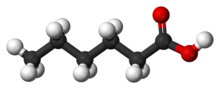
Caproic acid, also known as hexanoic acid, is the carboxylic acid derived from hexane with the chemical formula CH3(CH2)4COOH. It is a colorless oily liquid with an odor that is fatty, cheesy, waxy, and like that of goats[1] or other barnyard animals. It is a fatty acid found naturally in various animal fats and oils, and is one of the chemicals that gives the decomposing fleshy seed coat of the ginkgo its characteristic unpleasant odor.[3] It is also one of the components of vanilla and cheese. The primary use of caproic acid is in the manufacture of its esters for use as artificial flavors, and in the manufacture of hexyl derivatives, such as hexylphenols.[1] Salts and esters of caproic acid are known as caproates or hexanoates. Several progestin medications are caproate esters, such as hydroxyprogesterone caproate and gestonorone caproate.

Caproic acid
Skeletal formula
Ball-and-stick model
Names
Preferred IUPAC name
Hexanoic acid
Other names
Hexoic acid; Hexylic acid; Butylacetic acid; Pentylformic acid; 1-Pentanecarboxylic acid; C6:0 (Lipid numbers)
Identifiers
CAS Number
  • 142-62-1 check
3D model (JSmol)
  • Interactive image
Beilstein Reference
773837
ChEBI
  • CHEBI:30776 check
ChEMBL
  • ChEMBL14184 check
ChemSpider
  • 8552 check
ECHA InfoCard100.005.046 Edit this at Wikidata
EC Number
  • 205-550-7
Gmelin Reference
185066
KEGG
  • C01585 check
PubChem CID
  • 8892
UNII
  • 1F8SN134MX check
CompTox Dashboard (EPA)
  • DTXSID7021607 Edit this at Wikidata
InChI
  • InChI=1S/C6H12O2/c1-2-3-4-5-6(7)8/h2-5H2,1H3,(H,7,8) check
    Key: FUZZWVXGSFPDMH-UHFFFAOYSA-N check
  • InChI=1/C6H12O2/c1-2-3-4-5-6(7)8/h2-5H2,1H3,(H,7,8)
    Key: FUZZWVXGSFPDMH-UHFFFAOYAY
SMILES
  • CCCCCC(=O)O
Properties
Chemical formula
C6H12O2
Molar mass116.160 g·mol−1
AppearanceOily liquid[1]
Odorgoat-like
Density0.929 g/cm3[2]
Melting point−3.4 °C (25.9 °F; 269.8 K)[1]
Boiling point205.8 °C (402.4 °F; 478.9 K)[1]
Solubility in water
1.082 g/100 mL[1]
Solubilitysoluble in ethanolether
Acidity (pKa)4.88
Magnetic susceptibility (χ)
-78.55·10−6 cm3/mol
Refractive index (nD)
1.4170
Viscosity3.1 mP
Hazards
GHS labelling:
Pictograms
GHS05: CorrosiveGHS06: Toxic
Signal word
Danger
Hazard statements
H311H314
Precautionary statements
P260P264P280P301+P330+P331P302+P352P303+P361+P353P304+P340P305+P351+P338P310P312P321P322P361P363P405P501
NFPA 704 (fire diamond)
3
1
0
Flash point103 °C (217 °F; 376 K)[2]
Autoignition
temperature
380 °C (716 °F; 653 K)
Explosive limits1.3-9.3%
Lethal dose or concentration (LD, LC):
LD50 (median dose)
3000 mg/kg (rat, oral)
Related compounds
Related compounds
Pentanoic acidHeptanoic acid
Except where otherwise noted, data are given for materials in their standard state (at 25 °C [77 °F], 100 kPa).
check verify (what is check☒ ?)
Infobox references

Two other acids are named after goats: caprylic acid (C8) and capric acid (C10). Along with caproic acid, they account for 15% of the fat in goat's milk.

Caproic, caprylic, and capric acids (capric is a crystal- or wax-like substance, whereas the other two are mobile liquids) are not only used for the formation of esters, but also commonly used "neat" in: butter, milk, cream, strawberry, bread, beer, nut, and other flavors.


This article uses material from the Wikipedia article
 Metasyntactic variable, which is released under the 
Creative Commons
Attribution-ShareAlike 3.0 Unported License
.