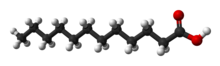
Lauric acid or systematically, dodecanoic acid, is a saturated fatty acid with a 12-carbon atom chain, thus having many properties of medium-chain fatty acids, is a bright white, powdery solid with a faint odor of bay oil or soap. The salts and esters of lauric acid are known as laurates.



Lauric acid was the most requested component for the production of superior quality napalm. With this coming in ~50% in the esterified form in coconut oil fatty acids.[10]
Occurrence
Lauric acid, as a component of triglycerides, comprises about half of the fatty-acid content in coconut milk, coconut oil, laurel oil, and palm kernel oil (not to be confused with palm oil),[11][12] Otherwise, it is relatively uncommon. It is also found in human breast milk (6.2% of total fat), cow's milk (2.9%), and goat's milk (3.1%).[11]
In various plants
- The palm tree Attalea speciosa, a species popularly known in Brazil as babassu – 50% in babassu oil
- Attalea cohune, the cohune palm (also rain tree, American oil palm, corozo palm or manaca palm) – 46.5% in cohune oil
- Astrocaryum murumuru (Arecaceae) a palm native to the Amazon – 47.5% in "murumuru butter"
- Coconut oil 49%
- Pycnanthus kombo (African nutmeg)
- Virola surinamensis (wild nutmeg) 7.8–11.5%
- Peach palm seed 10.4%
- Betel nut 9%
- Date palm seed 0.56–5.4%
- Durio graveolens (a species of durian) 1.31%.[13]
- Macadamia nut 0.072–1.1%
- Plum 0.35–0.38%
- Watermelon seed 0.33%
- Viburnum opulus 0.24-0.33%[14]
- Citrullus lanatus (egusi melon)
- Pumpkin flower 205 ppm, pumpkin seed 472 ppm
In Insects
- Black soldier fly Hermetia illucens 30-50 mg/100 mg fat.[15]
Properties
Although 95% of medium-chain triglycerides are absorbed through the portal vein, only 25–30% of lauric acid is absorbed through it.[16]
Like many other fatty acids, lauric acid is inexpensive, has a long shelf-life, is nontoxic, and is safe to handle. It is used mainly for the production of soaps and cosmetics. For these purposes, lauric acid is reacted with sodium hydroxide to give sodium laurate, which is a soap. Most commonly, sodium laurate is obtained by saponification of various oils, such as coconut oil. These precursors give mixtures of sodium laurate and other soaps.[12]
Laboratory use
In the laboratory, lauric acid may be used to investigate the molar mass of an unknown substance via the freezing-point depression. The choice of lauric acid is convenient because the melting point of the pure compound is relatively high (43.8°C). Its cryoscopic constant is 3.9°C·kg/mol. By melting lauric acid with the unknown substance, allowing it to cool, and recording the temperature at which the mixture freezes, the molar mass of the unknown compound may be determined.[17][citation needed]
Potential medicinal properties
Lauric acid increases total serum cholesterol more than many other fatty acids, but mostly high-density lipoprotein (HDL) (the "good" blood cholesterol). As a result, lauric acid has been characterized as having "a more favorable effect on total HDL cholesterol than any other fatty acid [examined], either saturated or unsaturated".[18] In general, a lower total/HDL serum cholesterol ratio correlates with a decrease in atherosclerotic risk.[19] Nonetheless, an extensive meta-analysis on foods affecting the total LDL/serum cholesterol ratio found in 2003 that the net effects of lauric acid on coronary artery disease outcomes remained uncertain.[20] A 2016 review of coconut oil (which is nearly half lauric acid) was similarly inconclusive about the effects on cardiovascular disease risk.
| This article uses material from the Wikipedia article Metasyntactic variable, which is released under the Creative Commons Attribution-ShareAlike 3.0 Unported License. |