Myristic acid (IUPAC name: tetradecanoic acid) is a common saturated fatty acid with the molecular formula CH3(CH2)12COOH. Its salts and esters are commonly referred to as myristates or tetradecanoates. It is named after the binomial name for nutmeg (Myristica fragrans), from which it was first isolated in 1841 by Lyon Playfair.[12]
Myristic acid[1] |
 |
| Names |
|---|
| Preferred IUPAC name |
| Other names C14:0 (Lipid numbers) |
| Identifiers |
|---|
CAS Number | - 544-63-8

|
3D model (JSmol) | |
| ChEBI | - CHEBI:28875

|
| ChEMBL | - ChEMBL111077
|
| ChemSpider | - 10539
|
| ECHA InfoCard | 100.008.069  |
| EC Number | |
IUPHAR/BPS | |
| |
| RTECS number | |
| UNII | - 0I3V7S25AW
|
| - DTXSID6021666
|
InChI=1S/C14H28O2/c1-2-3-4-5-6-7-8-9-10-11-12-13-14(15)16/h2-13H2,1H3,(H,15,16) Key: TUNFSRHWOTWDNC-UHFFFAOYSA-N InChI=1/C14H28O2/c1-2-3-4-5-6-7-8-9-10-11-12-13-14(15)16/h2-13H2,1H3,(H,15,16) Key: TUNFSRHWOTWDNC-UHFFFAOYAZ
|
|
| Properties |
|---|
Chemical formula | C14H28O2 |
| Molar mass | 228.376 g·mol−1 |
| Appearance | colorless or white solid |
| Density | 1.03 g/cm3 (−3 °C)[2]
0.99 g/cm3 (24 °C)[3]
0.8622 g/cm3 (54 °C)[4] |
| Melting point | 54.4 °C (129.9 °F; 327.5 K) [9] |
| Boiling point | 326.2 °C (619.2 °F; 599.3 K) at 760 mmHg
250 °C (482 °F; 523 K)
at 100 mmHg[4]
218.3 °C (424.9 °F; 491.4 K)
at 32 mmHg[3] |
Solubility in water | 13 mg/L (0 °C)
20 mg/L (20 °C)
24 mg/L (30 °C)
33 mg/L (60 °C)[5] |
| Solubility | Soluble in alcohol, acetates, C6H6, haloalkanes, phenyls, nitros[5] |
| Solubility in acetone | 2.75 g/100 g (0 °C)
15.9 g/100 g (20 °C)
42.5 g/100 g (30 °C)
149 g/100 g (40 °C)[5] |
| Solubility in benzene | 6.95 g/100 g (10 °C)
29.2 g/100 g (20 °C)
87.4 g/100 g (30 °C)
1.29 kg/100 g (50 °C)[5] |
| Solubility in methanol | 2.8 g/100 g (0 °C)
17.3 g/100 g (20 °C)
75 g/100 g (30 °C)
2.67 kg/100 g (50 °C)[5] |
| Solubility in ethyl acetate | 3.4 g/100 g (0 °C)
15.3 g/100 g (20 °C)
44.7 g/100 g (30 °C)
1.35 kg/100 g (40 °C)[5] |
| Solubility in toluene | 0.6 g/100 g (−10 °C)
3.2 g/100 g (0 °C)
30.4 g/100 g (20 °C)
1.35 kg/100 g (50 °C)[5] |
| log P | 6.1[4] |
| Vapor pressure | 0.01 kPa (118 °C)
0.27 kPa (160 °C)[6]
1 kPa (186 °C)[4] |
Magnetic susceptibility (χ) | -176·10−6 cm3/mol |
| Thermal conductivity | 0.159 W/m·K (70 °C)
0.151 W/m·K (100 °C)
0.138 W/m·K (160 °C)[7] |
Refractive index (nD) | 1.4723 (70 °C)[4] |
| Viscosity | 7.2161 cP (60 °C)
3.2173 cP (100 °C)
0.8525 cP (200 °C)
0.3164 cP (300 °C)[8] |
| Structure |
|---|
Crystal structure | Monoclinic (−3 °C)[2] |
Space group | P21/c[2] |
Lattice constant | a = 31.559 Å, b = 4.9652 Å, c = 9.426 Å[2] α = 90°, β = 94.432°, γ = 90° |
| Thermochemistry |
|---|
Heat capacity (C) | 432.01 J/mol·K[4][6] |
Std enthalpy of
formation (ΔfH⦵298) | −833.5 kJ/mol[4][6] |
Std enthalpy of
combustion (ΔcH⦵298) | 8675.9 kJ/mol[6] |
| Hazards |
|---|
| GHS labelling: |
Pictograms |  [10] [10] |
Signal word | Warning |
Hazard statements | H315[10] |
| NFPA 704 (fire diamond) | |
| Flash point | > 110 °C (230 °F; 383 K) [11] |
| Lethal dose or concentration (LD, LC): |
LD50 (median dose) | >10 g/kg (rats, oral)[11] |
| Related compounds |
|---|
Related compounds | Tridecanoic acid, Pentadecanoic acid |
Except where otherwise noted, data are given for materials in their standard state (at 25 °C [77 °F], 100 kPa). |
 verify (what is ?) verify (what is ?) |
| Infobox references |
| |
OccurrenceEdit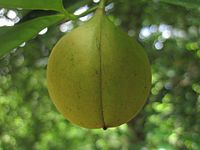
Myristica fragrans fruit contains myristic acid
Nutmeg butter has 75% trimyristin, the triglyceride of myristic acid. Besides nutmeg, myristic acid is also found in palm kernel oil, coconut oil, butterfat, 8–14% of bovine milk, and 8.6% of breast milk as well as being a minor component of many other animal fats.[9] It is also found in spermaceti, the crystallized fraction of oil from the sperm whale. It is also found in the rhizomes of the Iris, including Orris root.[13][14] It also comprises 14.49% of the fats from the fruit of the Durian species Durio graveolens.[15]
UsesEditSee also: Myristoylation
Myristic acid is commonly added to the N-terminus glycine in receptor-associated kinases to confer the membrane localization of the enzyme. The myristic acid has a sufficiently high hydrophobicity to become incorporated into the fatty acyl core of the phospholipid bilayer of the plasma membrane of the eukaryotic cell. In this way, myristic acid acts as a lipid anchor in biomembranes.[16]
Various "human epidemiological studies have shown that myristic acid and lauric acid were the saturated fatty acids most strongly related to the average serum cholesterol concentrations in humans",[17] meaning they were positively correlated with higher cholesterol levels as well as raising triglycerides in plasma by some 20% increasing the risk for cardiovascular disease, although some research points to myristic acid's positive effects on HDL cholesterol and hence improving HDL (good cholesterol) to total cholesterol ratio.[18]
Reduction of myristic acid yields myristyl aldehyde and myristyl alcohol.
