Pyridoxal

Pyridoxal is one form of vitamin B6.
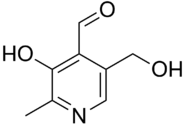
Pyridoxal
Skeletal formula of pyridoxal
Ball-and-stick model of pyridoxal
Names
Preferred IUPAC name
3-Hydroxy-5-(hydroxymethyl)-2-methylpyridine-4-carbaldehyde
Identifiers
CAS Number
  • 66-72-8 check
  • 65-22-5 (hydrochloride) check
3D model (JSmol)
  • Interactive image
ChEBI
  • CHEBI:17310 check
ChEMBL
  • ChEMBL102970 check
ChemSpider
  • 1021 check
DrugBank
  • DB00147 check
ECHA InfoCard100.000.573 Edit this at Wikidata
KEGG
  • C00250 check
PubChem CID
  • 1050
UNII
  • 3THM379K8A check
  • 1416KF0QBC (hydrochloride) check
CompTox Dashboard (EPA)
  • DTXSID4046020 Edit this at Wikidata
InChI
  • InChI=1S/C8H9NO3/c1-5-8(12)7(4-11)6(3-10)2-9-5/h2,4,10,12H,3H2,1H3 check
    Key: RADKZDMFGJYCBB-UHFFFAOYSA-N check
  • InChI=1/C8H9NO3/c1-5-8(12)7(4-11)6(3-10)2-9-5/h2,4,10,12H,3H2,1H3
    Key: RADKZDMFGJYCBB-UHFFFAOYAP
SMILES
  • O=Cc1c(O)c(C)ncc1CO
Properties
Chemical formula
C8H9NO3
Molar mass167.16 g/mol
Melting point165 °C (329 °F; 438 K) (decomposes)
Related compounds
Related arylformaldehydes
Damnacanthal

Gossypol

Except where otherwise noted, data are given for materials in their standard state (at 25 °C [77 °F], 100 kPa).
☒ verify (what is check☒ ?)
Infobox references

Some medically relevant bacteria, such as those in the genera Granulicatella and Abiotrophia, require pyridoxal for growth. This nutritional requirement can lead to the culture phenomenon of satellite growth. In in vitro culture, these pyridoxal-dependent bacteria may only grow in areas surrounding colonies of bacteria from other genera ("satellitism") that are capable of producing pyridoxal.

Pyridoxal is involved in what is believed to be the most ancient reaction of aerobic metabolism on Earth, about 2.9 billion years ago, a forerunner of the Great Oxidation Event. 


This article uses material from the Wikipedia article
 Metasyntactic variable, which is released under the 
Creative Commons
Attribution-ShareAlike 3.0 Unported License
.